';
FEATURE STORY

Louisiana: Let the good putts roll!

By John Gordon,
Associate Editor

NEW ORLEANS, La. (Nov. 3, 2003) -- To assume that New Orleans, Mardi Gras, and the French Quarter are representative of Louisiana is to be grievously mistaken. The Bayou State is a tangle of Creole, Cajun and voodoo, crawfish, soft-shell crabs and shrimp, zydeco, jazz and blues -- and now, a plethora of potential for golfers who revel in these and other creature comforts.

It is a wise man who knows his own limitations, my father used to say.

In that vein, I defer to the stunningly talented Louisiana novelist James Lee Burke to apprise you of what to expect outside the hurly-burly of New Orleans, the original Big Easy before Ernie Els appropriated that sobriquet.


"East Main Street in New Iberia is probably one of the most beautiful streets in the Old South or perhaps the whole country. It runs parallel with Bayou Teche and begins at the old brick post office and The Shadows, an 1831 plantation home that you often see on calendars and in motion pictures set in the antebellum South, and runs through a long corridor of spreading live oaks," Burke rhapsodizes about his hometown in his 1992 novel, A Stained White Radiance. "The yards are filled with hibiscus and flaming azaleas, hydrangeas, bamboo, blooming myrtle trees, and trellises covered with roses and bugle vine and purple clumps of wisteria. In the twilight, smoke from crab boils and fish fries drifts across the lawns and through the trees, and across the bayou you can hear a band or kids playing baseball in the city park."

The scene Burke paints is recreated in many Louisiana communities, a revelation for strangers who identify Louisiana solely with New Orleans -- French Quarter, the 16-square-block modern-day Gomorrah once known as Le Vieux Carre (the Old Square), and popularized in the writings of Tennessee Williams, Walker Percy, and Anne Rice.

This pulsating Pandora of the Crescent City shakes her booty non-stop, day and night, on the muddy banks of the Mississippi, reflecting the storied river?s swirling, murky depths in its often-seamy night life.

Having said that, any trip to Louisiana would be sadly incomplete without at least 24 hours in the company of the tarted-up trollop known as the French Quarter. And so, purely in the interests of research, you understand, it was there that our recent excursion began.

We eschewed standard accommodations in chains such as Hilton and Marriott in favor of the International House, a historic boutique hotel just a couple of blocks outside the Quarter. From there, we crossed Canal Street, entered the fabled dark heart of the city, and began stroking items off every first-time visitor's "must do" list: Café au lait and cloud-light, sugar-dusted beignets (calling them doughnuts is "tres, tres gauche") at Café du Monde, a stroll down boozy, boisterous Bourbon Street, a tour of the fine arts galleries on Royal Street, and dinner at one of the city's finest restaurants.

Choosing the right place to dine was a delicious dilemma. It was in New Orleans that Emeril Lagasse made his reputation, now writ large across the city at Emeril's, Nola, and two other eateries, not to mention The Food Network.

Dinner at Antoine's is a New Orleans tradition, commemorated for eternity in the famous 1947 novel of the same name, penned by Francis Parkinson Keyes. The culinary, if not literary, counterpoint is Breakfast at Brennan's, spanning hours and dozens of menu offerings. Start with an eye-opener of absinthe suissesse (Pernod, orgeat, egg white and cream), followed by turtle soup, and Eggs Hussard (poached eggs on Holland rusks, Canadian bacon and Marchand de Vin sauce, topped with hollandaise). The famous dessert Bananas Foster was invented in this Royal Street shrine -- bananas sautéed in butter, brown sugar, cinnamon and banana liqueur, then flamed in rum, and served over vanilla ice cream.

Breakfast didn't fit into our timetable, so we opted for dinner at Brennan's, an equally exquisite experience, as befits a half-century-old institution that's played a key role in the careers of many superb chefs, including Emeril.

We sampled fork-tender filets, crab-stuffed crepes, and blackened redfish. We whet our appetites with distinctive New Orleans cocktails: potent Sazeracs for the men and sophisticated Mr. Funks for the women. Sazerac, apparently, is Creole for "Mississippi Delta jet fuel" and is integral to a game played among New Orleans waiters: "Let's see which of these damn Yankees passes out first into his Bananas Foster." In contrast, a gentile combination of champagne, cranberry juice, and peach schnapps creates Mr. Funk, named for the late cellar master at Brennan's. He probably needed this libation as a respite from overseeing the restaurant's store of some 35,000 bottles of wine.

While the motto of Mardi Gras is "Laissez le bons temps rouler" ("Let the good times roll"), that could be amended for our purposes to "Laissez le bons putts rouler." PGA Tour fans will not want to miss the Nicklaus-designed English Turn layout, site of the PGA Tour's Compaq Classic. Numerous other courses exist both within the city limits and nearby. The Tournament Players Club at Fairfield, just 20 minutes from downtown, is in the planning stages and is expected to host the Compaq Classic in 2005.

They are a topic for another time, as our itinerary on this occasion took us to far-flung courses of lesser renown, but not necessarily lesser stature. Our four-day timetable allowed us to survey three of the courses on Louisiana's innovative Audubon Golf Trail. While the idea of a statewide golf trail is not altogether new (Alabama has the Robert Trent Jones Trail, for example), this rendition offers a novel twist. All are members of the Audubon Cooperative Sanctuary Program, which promotes ecologically sound land management and the conservation of natural resources.

This approach is bolstered by the fact that renowned naturalist and artist John James Audubon created many of his famous Birds of America paintings in the Bayou State a century and a half ago. That fact is reinforced on the scorecard of The Bluffs on Thompson Creek, near St. Francisville, northwest of New Orleans.

"To leave these sweet woods was painful, for in them we always enjoyed peace and the sweetest pleasures of admiring the greatest of the Creator in all His unrivalled works," the scorecard quotes Audubon.

Risking accusations of blasphemy in the ongoing pursuit of a golf analogy, the "creators" of "the unrivalled works" at The Bluffs were Arnold Palmer and his colleagues Ed Seay and Harrison Minchew. The result is a tremendous test of golf, beginning in earnest with the 543-yard, par-5 ninth hole and its split fairway.

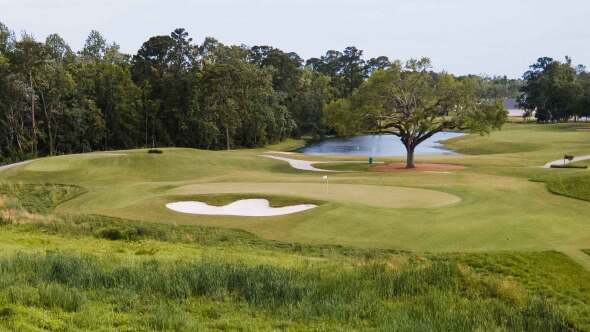
Taking the less dangerous high road requires no fewer than three shots to reach the green, while busting a drive to the lower fairway tier presents an opportunity to get home in two. It is a low-percentage gamble, but the testosterone factor is off the scale. The 223-yard, par-3 17th is a terrific hole from the back tee, demanding a fairway wood or long iron from an elevated tee to a kidney-shaped green that juts out into a small lake. The par-5 finishing hole is all uphill, with a fairway flecked with bunkers.

Adding to the exhilarating experience are the greens that rank with the finest anywhere. Constant elevation changes create club-selection challenges, so it would be imperative to stay overnight in the on-site villas and play this one at least twice. Don't take just my word for it: GOLF Magazine has ranked The Bluffs 34th on its list of Top Courses You Can Play, and GolfWeek included it among its Top 100 Modern Courses in America.

After feasting on crawfish etouffee' (crawfish -- the locals call them mudbugs -- smothered in a roux-thickened sauce replete with onions, celery, garlic, tomatoes, and peppers) at the romantic Myrtles Plantation's Carriage House, we traipsed over to the nearby Rosedown Plantation. Rosedown, rescued from carpetbaggers when it was purchased by the state, is surrounded by fragrant formal gardens and contains many pieces of furniture and other artifacts dating back almost 200 years. It remains a pristine example of the plantation mansions which dot southern Louisiana like -- mudbugs in a rice paddy.

For more information on the Audubon Golf Trail, call (877) 646-5352 or visit audubongolf.com. Prices average between $45 and $65, with a power cart.

For a free Louisiana tour guide and travel planning kit, call (800) 99-GUMBO or visit louisianatravel.com. Mardi Gras takes place in New Orleans, and other Louisiana cities in late February or early March. Book months ahead if you plan to go.

Information on this and other New Orleans activities is available by calling (800) 672-6124, or by visiting neworleanscvb.com. Other attractions not to be missed in New Orleans include the heartwrenching and inspiring National D-Day Museum (ddaymuseum.org). An insight into the cuisine can be found at brennansrestaurant.com, and details on the International House Hotel can be found at ihhotel.com. As with every destination, an up-to-date edition of Fodor's is essential reading and is available from bookstores, libraries, or by visiting fodors.com.

The weather from June through September redefines ?hot and humid.? You can expect occasional heavy rain from June through November. Early spring is generally recommended as the ideal time to visit Louisiana. Daytime highs average 71 in March, 77 in April, and 83 in May.

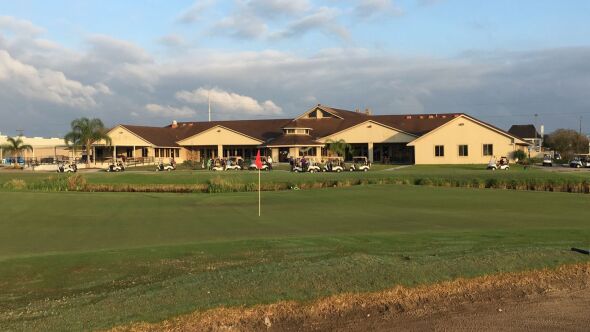
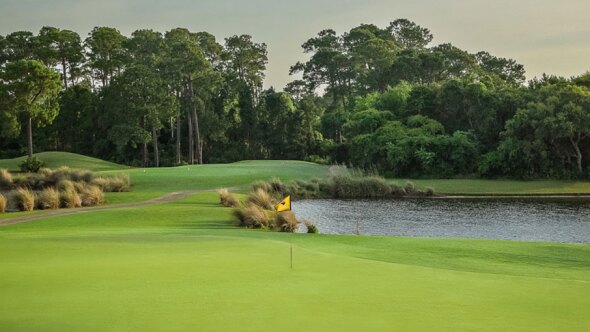
Our next outing was at Gray Plantation in Lake Charles, about 50 miles from the Texas border. The 6,900-yard Gray Plantation course was designed by William (Rocky) Roquemore of Lakeland, Georgia, former partner of Joe Lee who was, in turn, mentored by the renowned Dick Wilson. Roquemore demonstrated both that impressive heritage and admirable restraint in creating the links-style layout, on which 12 holes feature water covering some 60 acres in total.

The par-3s are strong, with two presenting island greens. Golf Digest's ranking panel named Gray Plantation the third-best new course in the country in 2000.

Dinner that night was a "roll-up-yer-sleeves and chow down" deal, a 22-napkin occasion if memory serves, at Steamboat Bill's in Lake Charles, across the road from Harrah's Casino. Bowls of gumbo (a savory stew-like mixture of seafood, chicken, sausage, etc., thickened with roux or file powder, and served with rice) were followed by pistolettes (heavenly bread rolls stuffed with shrimp etouffee) and then platters the size of garbage-can lids which served as funeral byres for scores of deep-red, spicy, boiled crawfish. Spending a couple of hours swilling all that down and quelling the Tabasco fires with a few locally brewed Abita lagers prepared us for our final round of the trip, at Plaquemine's The Island.

Just 11 miles south of Baton Rouge, the state capital, The Island reposes on a former sugar plantation. Georgia architect Mike Young was confronted with pancake-flat acreage relieved only by a stream which figures far too predominately, although not by his choice. The stream and associated ponds were a necessary evil, since the entire 7,000-yard course is composed of fill excavated from them. The result is a course only slightly less flat than the cane fields which surround it. While The Island is a decent layout, it is largely uninspiring, due to the intrusion of housing and the construction challenges.

If we were disappointed by the golf course, our spirits were lifted after the round by a delectable Cajun-inspired lunch prepared by the irrepressible Chef Ya Ya (aka Chris Raby), whose seafood gumbo, pork-roast sandwiches, and jalapeno-spiced hushpuppies elevated those everyday dishes to heavenly heights.

Other facilities included on this peek at nascent Audubon Trail on this trip come highly recommended. The 27 holes at Olde Oaks in Shreveport bear the name of design consultant and local hero Hal Sutton of PGA Tour fame. Cypress Bend Resort and Conference Center near Many, on the Louisiana-Texas border, overlooks the 186,000-acre Toledo Bend Lake, renowned for bass fishing. Aside from water on 10 holes, Cypress Bend offers the challenges of carrying hidden coves and bayous and avoiding hardwood forests. Tamahka Trails in Marksville is located at the Paragon Resort and Casino. Steve Smyers had the luxury of 230 acres of gently rolling, well-treed landscape to create the course, and threw in dozens of cavernous bunkers for good measure.

In general, these Audubon Trail selections are the cornerstones of several other courses in their locales. Sketching out a vacation could include any number of tracks in any region of the state, with the intervening hours filled with experiencing the Louisiana described so lyrically by James Lee Burke and others. Among them would be Lafcadio Hearn whose words, although specifically about New Orleans, could be applied to the entire state: "[Her] glamour [is] strongest upon them whom she attracts to her from less hospitable climates, and fascinates by her nights of magical moonlight, and her days of dreamy langours and perfumes. There are few who can visit her for the first time without delight, and few who can ever leave her without regret, and none who can forget her strange charm when they have once felt its influence."

Consider yourselves warned.

Any opinions expressed above are those of the writer and do not necessarily represent the views of the management. The information in this story was accurate at the time of publication. All contact information, directions and prices should be confirmed directly with the golf course or resort before making reservations and/or travel plans.