


Lost Key Golf Club

Rating Snapshot


About
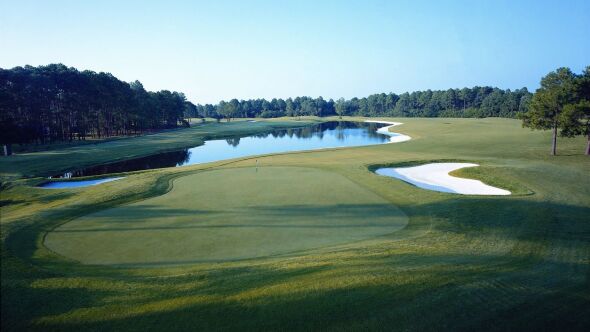
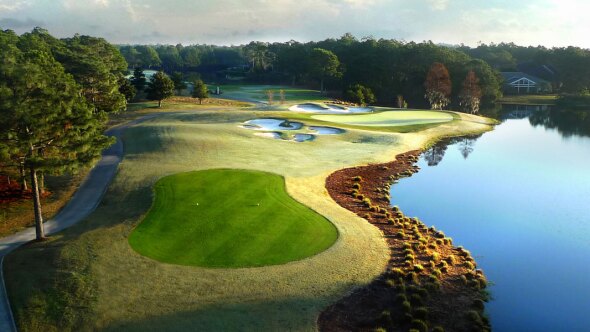
Lost Key Golf Club is conveniently situated equidistant from the historic downtown area of Pensacola and the pristine white sand beaches of Orange Beach and the Gulf Shores. The Arnold Palmer-designed layout was Florida's first golf course to be certified as an Audubon International Silver Signature Sanctuary. It underwent a major renovation in 2006 that included the addition of 2,200 native trees, 13,000 wetland plantings, and the resurfacing of the tees, greens, fairways, and rough. The golf course now presents a formidable test for even the most seasoned golfers. The greens are large and undulating and the flat fairways are lined with trees. There are also doglegs fairways on six holes and sand bunkers on several others. Lost Key Golf Club's signature hole is the par-3 13th hole, which requires a tee shot over water to a partial island green that rolls across dramatic elevation changes.
| Tee | Par | Length | Rating | Slope |
|---|---|---|---|---|
| Black | 72 | 6801 yards | 73.9 | 145 |
| Blue | 72 | 6447 yards | 72.3 | 141 |
| White | 72 | 6002 yards | 70.2 | 129 |
| Gold | 71 | 5179 yards | 66.8 | 113 |
| Red (W) | 71 | 4807 yards | 69.6 | 122 |
| Orange | 71 | 4137 yards | 62.5 | 102 |
| Hole | 1 | 2 | 3 | 4 | 5 | 6 | 7 | 8 | 9 | Out | 10 | 11 | 12 | 13 | 14 | 15 | 16 | 17 | 18 | In | Total |
|---|---|---|---|---|---|---|---|---|---|---|---|---|---|---|---|---|---|---|---|---|---|
| Black M: 73.9/145 | 578 | 208 | 390 | 324 | 439 | 524 | 205 | 436 | 396 | 3500 | 427 | 158 | 516 | 152 | 410 | 385 | 197 | 445 | 500 | 3190 | 6690 |
| Blue M: 72.3/141 | 549 | 185 | 374 | 292 | 413 | 498 | 178 | 412 | 388 | 3289 | 415 | 147 | 501 | 147 | 373 | 372 | 166 | 430 | 492 | 3043 | 6332 |
| White M: 70.2/129 | 507 | 171 | 368 | 276 | 375 | 488 | 169 | 384 | 357 | 3095 | 368 | 132 | 460 | 136 | 354 | 349 | 133 | 410 | 465 | 2807 | 5902 |
| Gold M: 66.8/113 W: 71.5/131 | 459 | 147 | 333 | 221 | 362 | 447 | 144 | 349 | 310 | 2772 | 339 | 120 | 382 | 118 | 325 | 314 | 110 | 378 | 385 | 2471 | 5243 |
| Red M: 65.0/109 W: 69.6/122 | 423 | 137 | 297 | 203 | 279 | 400 | 119 | 318 | 284 | 2460 | 307 | 101 | 377 | 107 | 320 | 314 | 103 | 336 | 382 | 2347 | 4807 |
| Orange M: 62.5/102 W: 65.3/112 | 385 | 132 | 234 | 137 | 260 | 378 | 100 | 283 | 224 | 2133 | 246 | 101 | 345 | 100 | 235 | 239 | 100 | 295 | 343 | 2004 | 4137 |
| Handicap | 13 | 11 | 5 | 17 | 3 | 15 | 9 | 1 | 7 | 4 | 12 | 16 | 18 | 6 | 8 | 14 | 2 | 10 | |||
| Par | 5 | 3 | 4 | 4 | 4 | 5 | 3 | 4 | 4 | 36 | 4 | 3 | 5 | 3 | 4 | 4 | 3 | 4 | 5 | 35 | 71 |
| Handicap (W) | 15 | 9 | 17 | 3 | 7 | 11 | 5 | 1 | 13 | 4 | 12 | 10 | 16 | 18 | 8 | 6 | 2 | 14 |
Course Details
Rentals/Services
Practice/Instruction
Policies
Food & Beverage
Bar, RestaurantAvailable Facilities
Clubhouse, Lounge, Locker RoomsReviews
Reviewer Photos
-
Middle of the fairway on 18… this course was $85 outrageous Photo submitted by Blake9492143 on 03/24/2024
-
Tee box Photo submitted by Orangecrush98 on 08/25/2023
-
In the pro shop Photo submitted by iamahockeynut19 on 04/09/2022
-
5’-6’ away on 16 Par 3. Pretty close for a hole-n-one. Got the bird though! Great course. Photo submitted by stepgarr2 on 08/05/2021
-
Hole 17 tee box Photo submitted by iamahockeynut19 on 04/07/2021
-
Photo submitted by iamahockeynut19 on 04/07/2021
-
Photo submitted by iamahockeynut19 on 04/07/2021
-
"Family Selfie" Photo submitted by u414880767 on 09/08/2020
-
Photo submitted by u7420117 on 08/05/2020
-
14th hole Photo submitted by BrandonWebb on 10/15/2018
-
9th green Photo submitted by BrandonWebb on 10/15/2018
-
11th hole Photo submitted by BrandonWebb on 10/15/2018
-
14th hole Photo submitted by BrandonWebb on 10/15/2018
-
13th hole Photo submitted by BrandonWebb on 10/15/2018
-
13th hole Photo submitted by BrandonWebb on 10/15/2018
-
Approach to No. 9 Green Photo submitted by ShragMagtite on 10/09/2017

Lost Key is Fun but…
Lost Key is a fun golf course but you better hit the ball straight. It has amazing greens but if you barely miss the green, you could lose your ball in the swamp and/or deep grass. I recommend grabbing a few extra balls and have fun on this course.
Great round at Lost Key
Very friendly staff and a challenging course. We were commenting about the amazing conditions of the greens. This is a tight course with very challenging second shots. The clubhouse is nice and we enjoyed the restaurant. If you want to play something different than the usual layout and don't mind losing a few golf balls, then this is a fun opportunity.

I will probably never play it again. Only because it's narrow and loaded with traps. Beautiful course. I've never seen Greens as plush as these. I'd like to take them back to my home course.
Tight Course, Great Greens
This is a very tight course. No matter how good you are you’re going to lose golf balls. There is no rough . Just fairway then trees, sand or swamp. As with all Palmer courses the sand traps are numerous and deep.
However, the greens are in the best shape of anywhere I play. True roll, little fast but fair. The greens are also big.
If you can keep your driver in the bag it is a real test of golf. I recommend it.
Thank you so much for the great review. We are glad you had an incredible time, and we hope to see you again soon! Thanks for choosing Lost Key Golf Club.
In rough condition
This course is in rough condition compared to what it's been in the past. Weeds all over tee boxes, fairways and green fringes. Greens are patchy and slow. Some fairways have large patches of dirt. I'm not sure what happened to it, because just a year ago it was in great condition. Hopefully they can turn this course around and get it back to what it was, because the layout is fun for the experienced golfer when it's in good condition.
We apologize for the current condition of the course and appreciate your feedback as it highlights areas we need to address. Rest assured, we are working diligently to return the course to its former glory and enhance your future golfing experience.
4 stars
Greens were excellent. A bit grassy/weedy on tee boxes and fairways but we are in transition from spring to summer. Driving range was in poor shape compared to prior visits. Staff is excellent. Amenities are good.
Hi, we appreciate you taking the time to review the course and rate us. Thank you for the 4 stars! We aim for a 5-star experience, so we always welcome feedback for improvement. Thank you for playing Lost Key Golf Club.
Day of Frustration…Kinda
A couple of friends & I played Lost Key yesterday and had a mixed outing. I’ve played the course a couple of times in the past years and thought it deserved its nickname “Lost Ball”, but I thought I’d give it another chance.
It’s a challenging layout due to the lack of bail out room. Essentially, if you’re not in the fairway you’ve just lost your ball. It’s not an exceptionally hard course, just unforgiving. I think I lost about 8 balls total mostly due to my ineptitude.
The one thing that really got us was the six-some playing ahead of us. We really struggled on the front nine because we could not get in a rhythm after the third hole. Once we made the turn we were able to jump ahead and the golf improved significantly. I still struggled on a couple of holes,12 & 18 in particular, but the pace was much improved. BTW, never saw a marshal.
Other than those few issues, it was a pleasant day of golf. I would play it again.
Thank you for sharing your experiences at Lost Key. We apologize for the pace of play issues caused by the group ahead of you and will work on ensuring better course management for a smoother experience in the future.
Range Balls
Why have they stopped including range balls in the green fees as before ?
Inadequate rest-room facility.
We appreciate you taking the time to review the course and rate us. We are going to pass on your feedback to the team. Thanks for visiting Lost Key Golf Club, and we hope to see you again in the future.
Great course
My wife and I had a chance to play this course and it was an awesome experience. The staff were friendly and helped us along the way to a few tees. I really liked the layout and there's quite a few holes that you can get aggressive on to score low. I played a 4 pm round and easily got 18 in. Great pace of play and was in really nice condition. If we visit the area mect year I'll be stopping in for sure.
Thank you so much for the great review. We are glad you had an incredible time, and we hope to see you again soon! Thanks for choosing Lost Key Golf Club.
Not a easy resort course
I played Lost Key aka Lost Ball in Perdido early this morning. 141 slope rating on a 6300 yard golf course from blues. Arnold Palmer was having a rough day when he built. There is very little room and water, deep bunkers and wicked stuff everywhere. Big gators in the ponds. Just to underscore how hard the place is Bubba Watson has the course record with a 63 and its 6600 from the back. Greens are 10/10. Had fun!
Hi, we appreciate you taking the time to review the course and rate us. Thank you for the 4 stars! We aim for a 5-star experience, so we always welcome feedback for improvement. Thank you for playing Lost Key Golf Club.
Very challenging course
Haven't played this since last year. Greens very nice. Areas around green quite bare and hard to hit from. Staff great overall good experience.
Hello, thanks so much for your rating and feedback. We hope to see you again soon!




Best of Gulf Shores Golf Package
Robert Trent Jones Golf Trail – The Grand Stay & Play Package

Robert Trent Jones Golf Trail – Best of Mobile Package
Sandestin Golf & Beach Resort Package

Hello, thank you for visiting us at Lost Key Golf Club. We appreciate your 4-star rating and feedback. We hope you join us for another round soon.